Solid Brass vs. Brass-Plated Faucets: What Is the Difference?
When shopping for kitchen or bathroom fixtures, it is easy to assume that every faucet advertised as brass offers the same quality. However, solid brass vs. brass-plated faucets is an important comparison for homeowners who want long-lasting performance, beautiful finishes, and lasting value.
Although solid brass and brass-plated faucets can look nearly identical when new, their underlying materials are different. A solid brass faucet is made primarily from a copper-and-zinc alloy, while a brass-plated faucet typically uses a different base material covered with a thin brass-colored layer. These differences can influence durability, maintenance, appearance, and long-term ownership costs.
For homeowners investing in a bathroom renovation, a luxury kitchen, or a timeless interior design, understanding faucet construction can help prevent costly mistakes.
At Brassena, homeowners can explore thoughtfully designed kitchen and bathroom fixtures and learn more about the materials, finishes, and details that contribute to a refined living space.
What Is the Difference Between Solid Brass and Brass-Plated Faucets?
The main difference is the material beneath the surface.
Solid brass faucets are constructed from brass for their main bodies and other specified structural components. Brass is an alloy composed primarily of copper and zinc, valued for its durability, workability, and corrosion resistance.
Brass-plated faucets, by comparison, typically feature a base made from another material, such as zinc alloy or steel, covered with a thin decorative brass layer. Some faucets advertised as having a brass finish may also use other types of coatings rather than actual brass plating.
This distinction matters because the surface appearance alone does not tell you what the faucet is made of.
A faucet with a gold-colored finish is not necessarily solid brass. Similarly, a solid brass faucet can feature a variety of finishes, including polished brass, brushed brass, chrome, or other decorative treatments.
When comparing products, examine both the underlying construction material and the finish.
What Is a Solid Brass Faucet?
A solid brass faucet uses brass as its primary structural material rather than relying on a different metal underneath a decorative brass coating.
Brass has been widely used in plumbing fixtures because it can be shaped into detailed designs and offers a useful combination of strength, machinability, and resistance to corrosion under appropriate conditions.
1. Durable Construction
Solid brass is suitable for everyday kitchen and bathroom use. Faucets are regularly exposed to water, humidity, temperature changes, and frequent handling. A well-manufactured brass body can withstand these conditions for many years when properly installed and maintained.
The quality of the cartridge, seals, valves, connections, and manufacturing also matters. Solid brass construction alone does not guarantee that every faucet component will last equally long.
2. A Material That Can Age Beautifully
One distinctive characteristic of unlacquered solid brass is its ability to develop a natural patina.
As the surface reacts with air, moisture, and everyday handling, its color can gradually become deeper or more muted. Some homeowners appreciate this evolving appearance because it adds character to a bathroom or kitchen.
Other solid brass finishes use protective coatings to maintain a more consistent appearance. Therefore, buyers should distinguish between the underlying material and the surface treatment.
3. Long-Term Maintenance Options
Because the body is brass rather than a different metal hidden underneath a thin brass layer, solid brass fixtures offer greater flexibility when it comes to appropriate surface restoration.
However, not every finish should be polished. Lacquered, brushed, plated, and other treated surfaces require care suited to their particular finish.
Always follow the manufacturer’s maintenance instructions before using a metal polish or abrasive product.
4. Premium Design Possibilities
Brass is versatile enough to support traditional, transitional, and contemporary faucet designs.
From elegant widespread bathroom faucets to distinctive kitchen bridge faucets, brass can accommodate detailed shapes and decorative features that complement a range of interior styles.
Explore Brassena’s kitchen and bathroom fixtures to discover design ideas for a coordinated home renovation.
What Is a Brass-Plated Faucet?
A brass-plated faucet typically consists of a base material covered with a thin layer that provides a brass appearance.
Depending on the product, the base may be zinc alloy, steel, or another material. The coating may be applied through electroplating or another finishing process.
Brass-plated fixtures are not automatically poor quality. Their performance depends on the underlying material, coating quality, manufacturing standards, installation, and maintenance. However, buyers should understand that a decorative brass layer is not equivalent to a solid brass body.
1. A Decorative Outer Layer
The main purpose of brass plating is to create a particular appearance. It can give a faucet a warm golden color without requiring the entire body to be made from brass.
The thickness and durability of the coating vary by manufacturing method and product quality.
2. Potential Surface Wear
Over time, friction, scratches, cleaning chemicals, and moisture may damage a plated finish.
If the coating wears through, the base material can become visible. Depending on that material and the surrounding conditions, the exposed area may discolor, corrode, or deteriorate.
Unlike a solid brass body, a plated fixture cannot simply be polished through the worn coating to reveal more brass underneath.
3. A Potentially Lower Initial Cost
Brass-plated faucets may cost less upfront, making them attractive for projects with strict budgets.
However, the purchase price is only one consideration. Buyers should also evaluate expected service life, replacement expenses, warranty coverage, and the cost of installation.
For a frequently used kitchen or primary bathroom, investing in better construction may offer more value over time.
Solid Brass vs. Brass-Plated Faucets: Key Differences
The following comparison summarizes the most important considerations.
| Feature | Solid Brass Faucet | Brass-Plated Faucet |
|---|---|---|
| Main body material | Primarily brass | Another base material with a brass coating |
| Appearance | Natural brass or a separate decorative finish | Brass-colored outer layer |
| Durability | Generally offers durable structural construction | Depends on the base material and coating quality |
| Surface wear | Unlacquered brass can develop patina | Coating may wear through |
| Restoration | Some finishes can be polished or refinished appropriately | Worn plating is often difficult to restore |
| Maintenance | Depends on the finish and water conditions | Requires care to protect the coating |
| Initial price | Often higher | Often lower |
| Best consideration | Long-term material quality and design | Initial cost and intended use |
The most important point is that the faucet’s construction material and its visible finish are two separate characteristics. Understanding both helps you compare products more accurately.
5 Reasons to Choose Solid Brass Faucets
For homeowners comparing premium brass faucets in the United States, solid brass construction offers several potential advantages.
1. Greater Confidence in Material Quality
A faucet is a frequently used fixture that becomes part of your daily routine. Choosing a clearly specified solid brass body helps you understand what you are buying rather than relying solely on a decorative finish.
Look for detailed product specifications that identify the body material, water-contact components, cartridge, and included hardware.
2. Better Potential for Long-Term Value
A faucet’s lifetime cost includes more than its initial purchase price.
Consider the following simplified example:
- Faucet A costs $120 and needs replacement after four years.
- Faucet B costs $300 and lasts twelve years.
Over twelve years, Faucet A would require three purchases, totaling $360 before installation costs. Faucet B would cost $300 over the same period, assuming it performs as expected for twelve years.
These figures are illustrative, not guaranteed product lifespans. Actual results depend on construction quality, usage, water conditions, maintenance, and repairs.
The lesson is simple: compare expected ownership costs instead of considering price alone.
3. A Distinctive Natural Brass Appearance
Unlacquered brass is particularly appealing to homeowners who appreciate authentic materials.
Rather than maintaining exactly the same color indefinitely, an unlacquered surface gradually changes with its surroundings. This can complement natural stone, wood cabinetry, handmade tiles, and other materials used in high-end interiors.
If you prefer a consistent golden appearance, consider a suitable protective finish instead.
4. Design Flexibility
Solid brass faucets are available in many styles, including modern minimalist designs, vintage-inspired fixtures, traditional bathroom faucets, and statement kitchen fittings.
This versatility makes brass an attractive choice for homeowners who want to coordinate fixtures across multiple rooms.
Browse Brassena for inspiration when planning a cohesive kitchen or bathroom design.
5. Greater Potential for Surface Restoration
Unlacquered solid brass can often be polished to reduce oxidation and restore a brighter appearance, provided the manufacturer’s care instructions permit it.
This is different from a plated fixture whose decorative layer has worn away. Once the coating is damaged, restoring the original appearance may require specialized refinishing or replacing the fixture.
Remember that cartridges, seals, and other moving components can still require servicing in a solid brass faucet.
Are Brass-Plated Faucets Worth Buying?
Brass-plated faucets can be a reasonable choice in certain circumstances.
For example, they may suit a temporary renovation, a low-use guest bathroom, or a project where the initial purchase budget is the primary concern.
However, it is important to assess the specifications rather than assuming that every brass-plated faucet has the same limitations.
Before purchasing, consider these questions:
- What material is used for the faucet body?
- How is the brass-colored finish applied?
- Is the finish covered by a warranty?
- Are replacement cartridges and other parts available?
- Does the manufacturer provide clear cleaning instructions?
- Is the faucet certified for its intended plumbing application?
A well-made plated faucet may perform adequately for its intended use. Nevertheless, for a long-term renovation where material quality is a priority, a properly specified solid brass faucet is often worth considering.
How to Tell If a Faucet Is Solid Brass or Brass-Plated
Product descriptions sometimes use similar language for different materials. Use the following checks before making a purchase.
1. Read the Product Specifications
Start with the manufacturer’s technical description.
Look for explicit wording such as “solid brass faucet body” or “solid brass construction.” A statement such as “brass finish,” “brass tone,” or “brass-plated” describes the appearance or surface treatment, not necessarily the underlying body material.
Be cautious when a listing uses “brass faucet” without explaining the construction.
2. Check the Base Material
Determine whether the main faucet body is brass, zinc alloy, stainless steel, or another material.
Some faucets use different materials for different components. A brass body does not mean every internal part, handle insert, aerator, or connector is also brass.
Ask the manufacturer for clarification when the specifications are incomplete.
3. Consider Weight Carefully
Brass is relatively dense, so a solid brass faucet may feel substantial compared with a similarly sized fixture made from a lighter material.
However, weight alone is not proof of construction. A faucet may contain dense components or use a different heavy base metal.
Use weight only as a supporting clue, not as the final test.
4. Do Not Rely on a Magnet Alone
Brass is generally nonmagnetic, but so are several other metals commonly used in faucet construction.
A magnet that attracts strongly to an exposed steel component can provide useful information. A magnet that does not attract, however, does not establish that a faucet is solid brass.
Manufacturer specifications are more reliable than a simple home test.
5. Examine the Warranty and Certifications
A clear warranty can help you understand how the manufacturer supports its products.
For faucets used with drinking water, also check applicable lead-content requirements and relevant certifications. In the United States, NSF/ANSI/CAN 61 addresses health effects of drinking-water system components, while NSF/ANSI/CAN 372 addresses lead content.
A solid brass body should not automatically be assumed to be lead-free. Verify the specific product’s compliance and certifications.
Solid Brass Faucets vs. Brass-Plated Faucets for Bathrooms
Bathrooms expose faucets to moisture, soap, toothpaste, cleaning products, and repeated handling. These conditions make the quality of the underlying material and the finish particularly important.
A solid brass bathroom faucet can be a suitable choice for a powder room, guest bathroom, or primary suite. Its construction can support a long-term renovation, while the finish helps establish the room’s overall design.
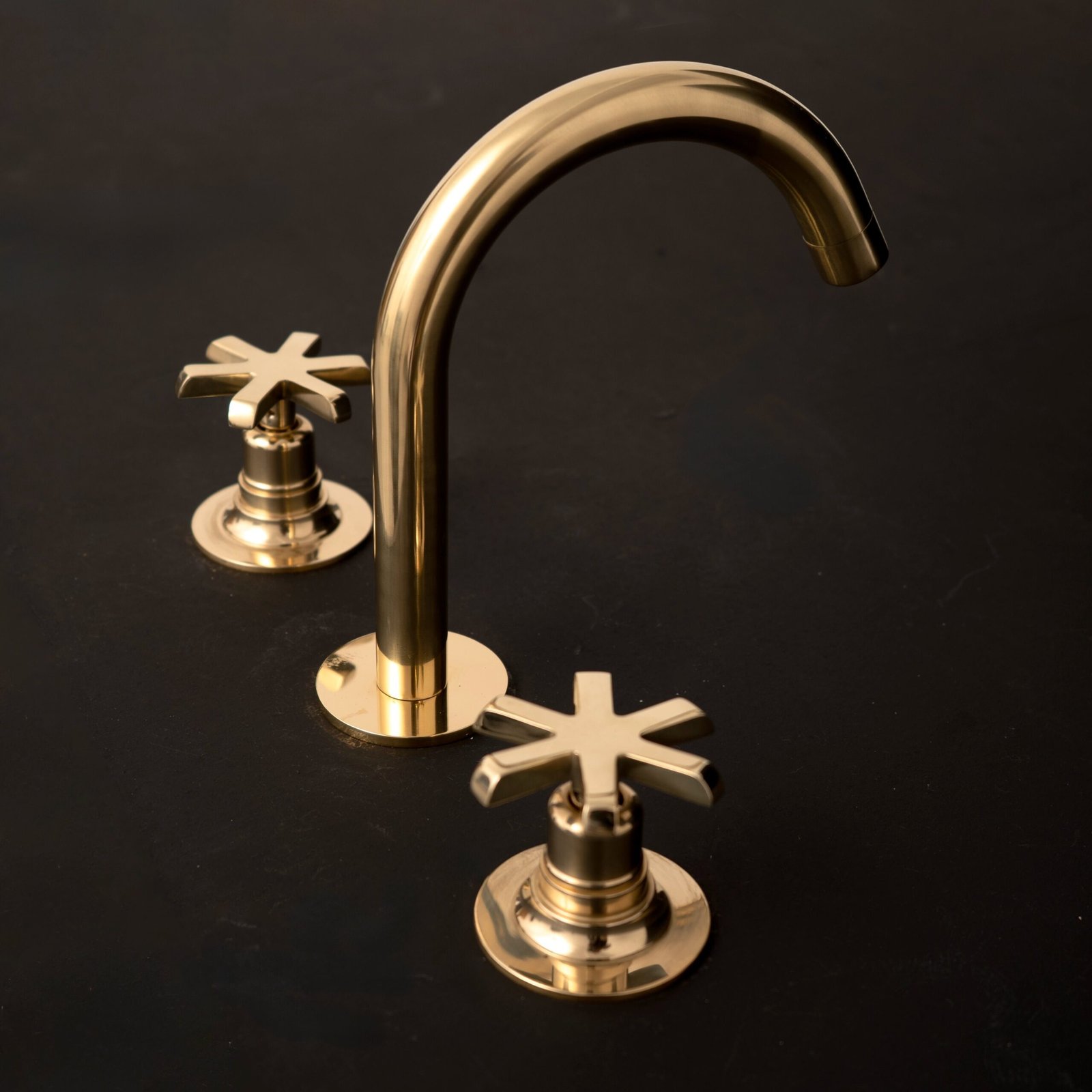
For example, an unlacquered brass widespread faucet can complement a natural stone vanity and warm wood cabinetry. A brushed brass finish may suit a more consistent, contemporary aesthetic.
Brass-plated faucets can also work in bathrooms, but their long-term appearance depends on the quality of the coating and the care they receive.
When selecting a bathroom faucet, pay attention to mounting style, hole spacing, spout reach, drain compatibility, and the available clearance around the sink.
Explore Brassena’s bathroom collection when comparing fixtures for a bathroom upgrade.
Solid Brass Faucets vs. Brass-Plated Faucets for Kitchens
Kitchen faucets often experience heavier use than bathroom fixtures.
They may be operated dozens of times a day and exposed to food residue, grease, hard-water deposits, and frequent cleaning. For that reason, both construction and finish deserve careful consideration.
A solid brass kitchen faucet can provide a durable body and support a wide variety of design styles. Depending on the model, you may find traditional bridge faucets, modern single-handle designs, or other configurations suited to different kitchen layouts.
Before choosing a faucet, evaluate:
- Spout height: Make sure it accommodates your pots and cookware.
- Spout reach: Confirm that water reaches the appropriate area of the sink.
- Handle operation: Choose a configuration that feels comfortable for everyday use.
- Finish durability: Check the manufacturer’s guidance for cleaning and wear.
- Water safety: Verify applicable lead-content requirements and certifications.
- Repairability: Confirm whether cartridges and replacement parts are available.
A high-quality faucet should balance appearance, practical functionality, and appropriate material specifications.
Discover more options at Brassena.
How to Maintain Solid Brass and Brass-Plated Faucets
The correct cleaning routine depends on the faucet’s finish, not just its body material.
Caring for Solid Brass Faucets
For routine cleaning, use a soft cloth and mild soap when permitted by the manufacturer. Rinse away residue and dry the surface to help minimize water spots.
For unlacquered brass, natural darkening and changes in tone are normal characteristics of the material. If you prefer the aged appearance, there may be no need to polish it.
If you want to restore a brighter finish, confirm that the faucet is suitable for polishing and use an appropriate product according to the manufacturer’s instructions.
Avoid aggressive cleaners, abrasive pads, and unapproved chemicals that could damage the surface.
Caring for Brass-Plated Faucets
Plated faucets benefit from gentle cleaning that protects the outer coating.
Use a soft cloth and an approved mild cleaning solution. Avoid abrasive powders, scouring pads, and harsh chemicals that could scratch the surface or weaken its protective finish.
Drying the faucet after use can help reduce mineral deposits, especially in areas with hard water.
If you notice peeling, bubbling, or exposed base metal, consult the manufacturer about repair options. Ordinary polishing will not replace missing plating.
Common Mistakes to Avoid When Buying a Brass Faucet
Several common misconceptions can lead to disappointing purchases.
Mistake 1: Assuming every gold faucet is solid brass. A gold or brass-colored finish does not establish the underlying material.
Mistake 2: Assuming solid brass means every component is brass. Faucet bodies, cartridges, aerators, seals, and connectors may use different materials.
Mistake 3: Ignoring the finish. Solid brass can have lacquered, unlacquered, brushed, polished, or other treatments, each with different maintenance requirements.
Mistake 4: Choosing based on price alone. A low initial price may be attractive, but warranty terms, repairability, and replacement costs also matter.
Mistake 5: Ignoring water safety. Material claims do not replace the need to verify applicable drinking-water certifications and lead-content compliance.
Mistake 6: Using the wrong cleaning products. Even premium fixtures can be damaged by abrasive cleaners or chemicals unsuitable for their finishes.
Avoiding these mistakes helps you choose a faucet that suits your home’s needs and your long-term expectations.
Frequently Asked Questions
Is solid brass better than brass-plated faucets?
Solid brass is often preferable when long-term material quality, durability, and restoration potential are priorities. Brass-plated faucets may cost less initially, but their performance depends on the base material and the quality of the coating.
Do solid brass faucets rust?
Brass does not rust in the same way iron or ordinary steel does. However, brass can tarnish, discolor, or experience corrosion under certain conditions. Water chemistry, cleaning products, and maintenance practices all influence its condition.
Do brass-plated faucets peel?
They can. If the decorative coating becomes damaged through friction, scratches, harsh cleaners, or prolonged exposure to moisture, it may peel or wear through. The likelihood depends on the coating quality and how the faucet is used.
Are unlacquered brass faucets the same as solid brass faucets?
No. Solid brass describes the underlying material, while unlacquered brass describes a surface without a protective lacquer coating. A faucet can be solid brass and have either a lacquered or unlacquered finish.
Are solid brass faucets worth the money?
They can be, particularly when you plan to keep the fixture for many years. Solid brass construction, suitable finish quality, replaceable components, and a good warranty may contribute to long-term value. Actual performance varies by product.
How can I tell whether a faucet is genuinely solid brass?
Check the manufacturer’s specifications for the main faucet body and request clarification if the material is unclear. Weight and magnet tests can offer clues, but neither provides definitive proof.
Do solid brass faucets need special cleaning?
Not necessarily. Many can be cleaned with a soft cloth and mild soap, subject to the manufacturer’s instructions. Unlacquered brass may develop a natural patina, while lacquered or specially finished brass requires care suited to its coating.
Are solid brass faucets safe for drinking water?
They can be suitable when the specific product meets applicable drinking-water requirements. Do not assume that every brass faucet is lead-free. Check the manufacturer’s compliance documentation and relevant certifications before purchasing.
Final Verdict: Solid Brass vs. Brass-Plated Faucets
When comparing solid brass vs. brass-plated faucets, the most important distinction is what lies beneath the visible finish.
Solid brass provides a durable structural material, offers different finishing possibilities, and can develop an attractive patina when left unlacquered. Brass-plated faucets provide a brass appearance over another base material and may be a practical option for projects where initial cost is the main consideration.
For a long-term kitchen or bathroom renovation, examine the body material, finish, warranty, replacement parts, and water-safety certifications before deciding.
The right faucet is not simply the one that looks best in a photograph. It is the one whose construction, functionality, finish, and maintenance requirements fit your home.
Explore Brassena to discover kitchen and bathroom fixtures and find inspiration for a more considered, lasting interior.
- Tags: Best Solid Brass Bathroom Faucets, High Quality Solid Brass Faucets, Solid Brass 3 Hole Bathroom Faucet, Solid Brass Bathroom Sink Faucet, Solid Brass Bathtub Faucet, Solid Brass Faucet Patina, Solid Brass Faucet vs Brass Plated Faucet, Solid Brass Faucets for Luxury Bathrooms, Solid Brass Faucets with Unlacquered Finish, Solid Brass Two Handle Bathroom Faucet, Solid Brass Vessel Sink Faucet, Where to Buy Solid Brass Faucets
Blog
Get fresh home inspiration and helpful tips from our interior designers