How to Choose a Brass Bathroom Faucet: A Complete Buyer’s Guide
Choosing the right bathroom faucet is an important step in creating a beautiful, functional, and long-lasting bathroom. With so many styles, finishes, mounting options, and materials available, finding the perfect fixture can feel overwhelming. However, understanding what to look for makes the decision much easier.
If you are wondering how to choose a brass bathroom faucet, start by considering the faucet’s material, design, installation requirements, finish, water flow, and compatibility with your sink. A well-chosen brass faucet can complement your bathroom’s interior design while providing dependable performance for years.
At Brassena, homeowners and design professionals can explore premium brass faucets and bathroom fixtures that combine timeless aesthetics with practical functionality. Whether you are renovating a traditional bathroom, designing a contemporary space, or creating a luxurious retreat, the right brass bathroom faucet can make a meaningful difference.
In this guide, we will explain the essential factors to consider before buying a brass bathroom faucet and help you choose a fixture that suits your style, needs, and budget.
1. Understand Why Brass Is a Popular Bathroom Faucet Material
Before comparing designs, it is important to understand why brass is widely used in bathroom fixtures.
Brass is an alloy primarily made from copper and zinc. It is valued for its durability, machinability, and suitability for plumbing applications. When properly manufactured and maintained, a quality brass faucet can provide reliable service over many years.
Durability and Everyday Performance
Bathroom faucets are used frequently and exposed to water, moisture, cleaning products, and temperature changes. A well-made brass faucet can withstand everyday use and offers a solid, substantial feel.
However, not every faucet marketed as brass is made entirely from brass. Some products use a brass body, while others have a different base material with a brass-colored surface coating.
When comparing products, review the manufacturer’s material specifications rather than relying on appearance alone.
Timeless Appearance
Brass complements a wide range of bathroom styles, from classic interiors to minimalist and contemporary spaces. Its warm metallic tones can create a sophisticated contrast with white porcelain, natural stone, marble, wood, and neutral-colored tiles.
Depending on the design, a brass bathroom faucet can become a subtle finishing detail or a prominent feature of the vanity.
Long-Term Value
A quality faucet should balance purchase price, material quality, functionality, maintenance, and expected service life. A lower-priced fixture may look attractive initially, but its overall value depends on construction quality, replacement-part availability, and the durability of its finish.
Explore the Brassena bathroom and home fixture collection to discover options for coordinating your bathroom design.
2. Choose Between Solid Brass and Brass-Plated Faucets
One of the most important decisions when choosing a brass bathroom faucet is understanding the difference between solid brass construction and a brass-colored finish.
What Is a Solid Brass Bathroom Faucet?
A solid brass faucet has a body made from brass, although individual components such as cartridges, seals, aerators, and handles may use other materials.
Solid brass construction is often valued for its strength, substantial feel, and suitability for long-term use. Nevertheless, product quality still depends on manufacturing standards, internal components, and proper installation.
What Is a Brass-Plated Faucet?
A brass-plated faucet has a base material covered with a thin brass-colored layer or decorative finish. The underlying material may be another metal or a different substrate, depending on the product.
Brass plating can provide an attractive appearance, but its durability depends on the coating process, surface preparation, and maintenance requirements.
Which Option Should You Choose?
If material quality and long-term use are priorities, compare solid brass construction with plated alternatives carefully. Ask the manufacturer for details about the faucet body, internal components, finish warranty, and replacement parts.
Do not assume that a brass-colored faucet is made from solid brass. Similarly, a solid brass body does not automatically guarantee that every component or finish is superior.
For additional guidance, read our brass faucet resources and product information before making your purchase.
3. Select the Right Brass Finish for Your Bathroom
The finish influences how your faucet looks, how it coordinates with other fixtures, and how much maintenance it may require.
Unlacquered Brass
Unlacquered brass is brass without a protective clear lacquer coating. Because the surface is exposed to air, moisture, and everyday handling, it can gradually develop a natural patina.
This evolving appearance is one of the main reasons homeowners and interior designers choose unlacquered brass bathroom faucets. The surface can develop deeper tones and subtle variations that give the fixture an individual character.
Keep in mind that patina develops differently depending on water quality, humidity, cleaning habits, and frequency of use. If you prefer a consistently uniform appearance, unlacquered brass may require more consideration than a sealed finish.
Polished Brass
Polished brass offers a bright, reflective appearance that can make a bathroom feel elegant and traditional. Depending on the product, polished brass may be lacquered or protected with another finish.
Check the manufacturer’s specifications because two polished brass faucets may have different maintenance requirements.
Brushed Brass
Brushed brass has a softer, less reflective surface. It works well in modern bathrooms, transitional interiors, and spaces where a subtle metallic accent is preferred.
Its appearance can coordinate particularly well with matte tiles, stone countertops, and understated cabinetry.
Antique Brass
Antique brass finishes provide a darker, aged appearance that suits vintage-inspired bathrooms and traditional interiors. They can complement natural materials and decorative hardware.
Practical tip: Compare the faucet finish with your bathroom’s cabinet pulls, shower fixtures, towel bars, lighting, and other metallic details. Matching every finish exactly is not essential, but coordinating their tones and visual weight helps create a balanced space.
4. Match the Faucet to Your Sink and Vanity
Even a beautiful brass faucet can be impractical if it does not fit the sink properly.
Before purchasing, measure the sink, countertop, faucet holes, and available clearance.
Single-Hole Faucets
Single-hole faucets combine the handle and spout into one compact assembly. They are suitable for many modern bathrooms and can simplify countertop cleaning.
They are particularly useful for smaller vanities where a clean, uncluttered appearance is desirable.
Centerset Faucets
Centerset faucets typically combine the spout and handles in a compact arrangement designed for compatible sink-hole spacing. Many models are designed around a 4-inch mounting configuration, but always confirm the manufacturer’s installation dimensions.
They are a practical choice for traditional bathroom sinks and standard vanity layouts.
Widespread Faucets
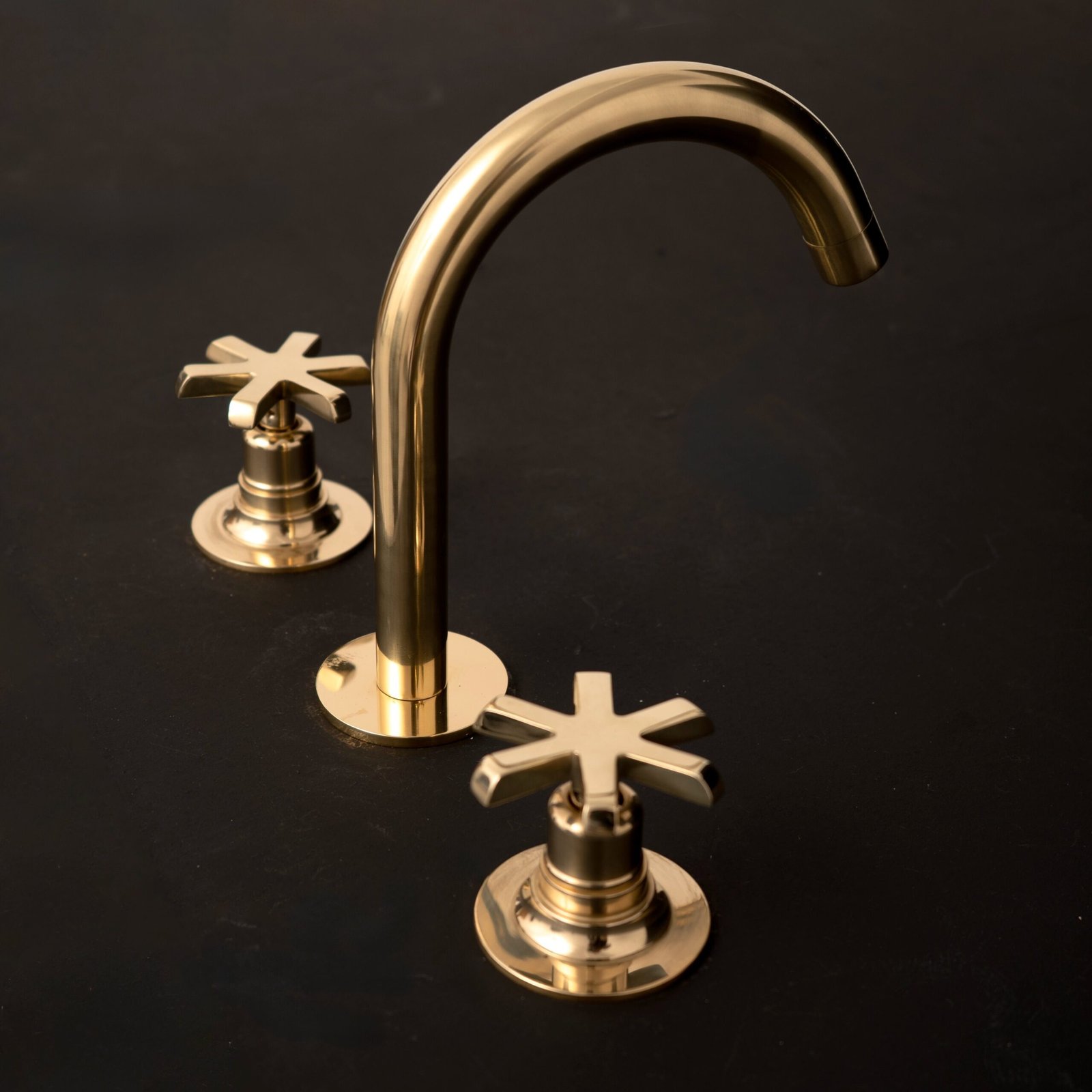
Widespread bathroom faucets feature separate hot and cold handles and a separate spout. The components are installed individually, allowing flexibility in their spacing within the manufacturer’s specified range.
A widespread brass bathroom faucet can create an elegant, balanced appearance on a larger vanity.
Explore the available Brassena faucet designs to compare styles suitable for different bathroom layouts.
Wall-Mounted Faucets
Wall-mounted brass faucets attach to plumbing inside the wall rather than directly to the sink or countertop. They create a clean, distinctive look and leave more countertop space available.
However, they require compatible plumbing and careful planning for spout reach and installation height. If you are renovating an existing bathroom, confirm whether the plumbing can accommodate a wall-mounted fixture before choosing this design.
Vessel Sink Faucets
Vessel sinks sit above the countertop and often require a taller faucet or a wall-mounted model.
Measure the height of the vessel and determine where the water stream should land. The faucet must provide enough clearance without placing the spout so high that water splashes excessively.
5. Choose a Faucet Style That Complements Your Bathroom
The best brass bathroom faucet should work with your overall design rather than look like an isolated decorative element.
Modern and Minimalist Bathrooms
Choose streamlined shapes, clean lines, and understated handles. Brushed brass can add warmth to white, gray, or neutral interiors without overwhelming the design.
A simple single-hole faucet or a carefully proportioned wall-mounted model can complement a contemporary vanity.
Traditional Bathrooms
Traditional interiors often pair well with curved spouts, decorative handles, and polished or antique brass finishes.
Consider the shape of the sink, mirror frame, cabinetry, and lighting when selecting a faucet. Coordinated details help reinforce a classic aesthetic.
Luxury Bathrooms
For a more luxurious appearance, focus on proportions, material quality, finish consistency, and the relationship between the faucet and the surrounding surfaces.
A widespread brass faucet can suit a spacious vanity, while a wall-mounted fixture may work well with a sculptural vessel sink.
Luxury does not necessarily mean choosing the most elaborate design. A carefully selected fixture with excellent construction and a suitable finish can create a refined result.
6. Check Water Flow and Faucet Functionality
Appearance matters, but functionality should be equally important when choosing a bathroom faucet.
Water Flow Rate
The flow rate indicates how much water the faucet delivers over time, commonly measured in gallons per minute (GPM) in the United States.
Check the product specifications and applicable local requirements. In the United States, bathroom sink faucets generally fall under federal water-efficiency requirements, including a maximum flow rate of 2.2 GPM at 60 psi under the applicable federal standard. State and local requirements or voluntary efficiency programs may set lower limits.
A well-designed faucet can deliver a comfortable washing experience without unnecessarily high water consumption.
Handle Operation
Consider whether you prefer a single handle or two separate handles.
A single-handle faucet allows you to adjust temperature and flow using one control. A two-handle faucet offers separate hot and cold controls and often suits traditional or widespread designs.
Choose an operating style that feels comfortable and is practical for everyone using the bathroom.
Cartridge Quality
The cartridge controls water flow and temperature. Its design and quality influence how smoothly the faucet operates and how easily it can be serviced.
Ask about cartridge type, replacement availability, and warranty coverage. These details are especially important if you want to keep the faucet for many years.
Spout Reach and Splashing
Spout reach refers to how far the faucet extends over the sink. A spout that is too short may direct water too close to the back of the basin, while a poorly positioned or overly high spout can contribute to splashing.
Check the faucet’s dimensions and compare them with the sink’s depth and shape before purchasing.
7. Consider Installation Requirements
Installation requirements can influence the overall cost and suitability of your new brass faucet.
Before ordering, confirm the following:
- The number and spacing of existing faucet holes.
- The countertop or sink thickness and mounting requirements.
- The location of hot and cold water supply lines.
- The available clearance beneath the sink.
- Whether the faucet includes the required mounting hardware and supply connections.
- Whether a drain assembly is included or must be purchased separately.
If you are replacing an existing faucet, choosing a model that matches the current mounting configuration may reduce installation complexity.
Wall-mounted faucets and some specialized designs may require additional plumbing work. For these installations, consult a qualified plumber before finalizing your purchase.
For more fixture ideas, visit Brassena and review the product information for your preferred bathroom faucet.
8. Understand Cleaning and Maintenance Requirements
Proper care helps preserve the appearance and performance of a brass bathroom faucet.
However, maintenance methods vary depending on the finish.
Cleaning Solid Brass Faucets
For most brass finishes, start with a soft cloth, warm water, and a mild soap if necessary. Rinse away soap residue and dry the surface to reduce water spots.
Avoid abrasive pads, harsh chemicals, and unapproved polishing compounds. These products may scratch or damage the finish.
Always follow the manufacturer’s care instructions.
Maintaining Unlacquered Brass
Unlacquered brass naturally changes appearance over time. Fingerprints, water exposure, and cleaning patterns can affect how the patina develops.
If you want to preserve its natural aging process, use gentle cleaning methods and avoid polishing the surface unnecessarily.
If you prefer a brighter appearance, check the manufacturer’s recommendations before using a brass polish. Polishing can remove or alter the patina and produce a less uniform appearance until the surface naturally changes again.
Preventing Water Spots
Wipe the faucet dry after cleaning or heavy use when practical. This is particularly helpful in bathrooms with hard water, where mineral deposits can accumulate.
Never assume that all brass finishes can be cleaned using the same method. Confirm the appropriate care procedure for your specific product.
9. Set a Realistic Budget and Compare Overall Value
The price of a brass bathroom faucet varies according to its construction, finish, design, brand, and included components.
Instead of comparing products by price alone, evaluate their overall value.
Consider these factors:
- Body material: Confirm whether the faucet body is solid brass or another material.
- Finish quality: Review the finish type, care instructions, and warranty.
- Internal components: Check cartridge specifications and replacement-part availability.
- Installation costs: Include plumbing changes and professional labor where necessary.
- Warranty: Understand what is covered and for how long.
- Long-term maintenance: Consider cleaning requirements and the availability of compatible parts.
A more expensive faucet is not automatically better. The goal is to select a fixture that meets your quality expectations, fits your bathroom, and provides the features you actually need.
Before purchasing, review the specifications and terms provided by the seller. If any material or finish description is unclear, request clarification.
10. Avoid Common Mistakes When Buying a Brass Bathroom Faucet
A few simple checks can prevent expensive or frustrating purchasing mistakes.
Choosing based on appearance alone: A faucet may look beautiful but still have unsuitable dimensions or mounting requirements. Check the technical specifications before ordering.
Confusing brass color with brass construction: A gold-colored finish does not prove that the faucet body is made from solid brass. Confirm the stated materials.
Ignoring sink compatibility: Spout reach, faucet height, mounting-hole spacing, and basin depth all affect usability.
Overlooking maintenance: Unlacquered brass develops a changing patina, while coated finishes have their own cleaning requirements. Choose a finish that matches your expectations.
Failing to check included components: Supply lines, mounting hardware, drain assemblies, and other accessories may be sold separately.
Neglecting warranty information: Review coverage for the faucet body, finish, and mechanical components. Understand any exclusions before purchasing.
Taking a few minutes to check these details can help you choose a fixture that looks appropriate and functions well in everyday use.
11. Why Consider Brassena for Your Bathroom Faucet?
When shopping for a premium bathroom fixture, look for a combination of attractive design, clear material specifications, useful product information, and compatibility with your renovation plans.
Brassena offers a destination for exploring brass faucets and complementary fixtures for bathroom and home projects. When comparing options, review each product’s construction, finish, dimensions, installation requirements, and care instructions to determine whether it fits your needs.
Whether you are planning a complete bathroom renovation or replacing a single fixture, selecting a faucet that complements your sink, vanity, and interior style can help create a cohesive result.
For a coordinated design, consider how the faucet will work with your shower fixtures, cabinet hardware, lighting, and other bathroom accessories. A consistent design approach can make even a relatively small update feel intentional.
Visit Brassena.com to explore the available collections and identify a brass faucet that suits your preferred style and functional requirements.
Frequently Asked Questions About Choosing a Brass Bathroom Faucet
1. How do I choose the best brass bathroom faucet?
Start by checking the faucet’s body material, finish, mounting style, dimensions, and internal components. Make sure it fits your sink and matches your preferred bathroom design. Review the warranty, maintenance instructions, and availability of replacement parts before buying.
2. Is a solid brass bathroom faucet better than a brass-plated faucet?
Solid brass construction is often valued for its substantial feel and durability. Brass-plated faucets can also provide an attractive appearance, but their performance depends on the underlying material and coating quality. Compare the complete product specifications rather than relying on appearance alone.
3. Are unlacquered brass bathroom faucets a good choice?
Unlacquered brass is a good option for homeowners who appreciate natural material changes and a developing patina. It may not be ideal for someone who wants the finish to remain uniform, because its appearance changes with use and environmental conditions.
4. What brass faucet finish is easiest to maintain?
Maintenance depends on the specific finish and manufacturer instructions. Protected finishes may be designed to maintain a more consistent appearance, while unlacquered brass naturally develops patina. Gentle cleaning and prompt drying help reduce water spots on many faucet finishes.
5. Can I install a brass bathroom faucet on any sink?
No. The faucet must be compatible with the sink’s mounting holes, dimensions, countertop arrangement, and plumbing connections. Vessel sinks may require taller faucets, while wall-mounted faucets require suitable in-wall plumbing.
6. What should I look for in a high-quality brass bathroom faucet?
Look for clear material specifications, reliable internal components, suitable flow performance, a finish that meets your expectations, accessible replacement parts, and a clear warranty. Correct sizing and professional installation also contribute to long-term performance.
7. How do I clean a brass bathroom faucet without damaging it?
Use a soft cloth and follow the manufacturer’s cleaning instructions. Avoid abrasive materials and harsh chemicals unless specifically approved. For unlacquered brass, remember that aggressive polishing can change or remove the natural patina.
8. Are brass bathroom faucets suitable for modern bathrooms?
Yes. Brass works well in modern bathrooms, especially when paired with simple shapes, clean lines, neutral colors, and natural materials. Brushed brass and minimalist faucet designs are popular choices for contemporary interiors.
9. Should bathroom faucets match shower fixtures?
They do not have to match exactly, but coordinating their tones, shapes, and overall style can create a more cohesive bathroom. Consider the faucet, shower hardware, cabinet pulls, towel bars, and lighting together when planning your design.
10. Where can I find brass bathroom faucets?
You can explore bathroom fixture options at Brassena. Review the available product details, material descriptions, dimensions, and care requirements to identify a suitable fixture for your bathroom.
Final Thoughts: Choose a Brass Bathroom Faucet with Confidence
Learning how to choose a brass bathroom faucet involves more than selecting a finish that looks attractive. The best choice combines suitable construction, reliable functionality, correct dimensions, manageable maintenance, and a design that complements your bathroom.
Start by confirming the material, then compare finishes such as unlacquered, polished, brushed, and antique brass. Check the sink configuration, spout reach, flow rate, installation requirements, and warranty before making a final decision.
With careful planning, a well-selected brass bathroom faucet can become a lasting part of your bathroom’s design.
Explore Brassena to discover brass faucets and complementary fixtures for your next bathroom project.
- Tags: Antique Brass Bathroom Faucet, Bathroom Faucet, Brass Bathroom Faucet, Brass Bathroom Faucets, Brass Sink Faucet, Brass Vanity Faucet, Brushed Brass Bathroom Faucet, Gold Brass Bathroom Faucet, Luxury Brass Bathroom Faucet, Modern Brass Bathroom Faucet, Single Hole Brass Bathroom Faucet, Solid Brass Bathroom Faucet, unlacquered brass bathroom faucet, Vintage Brass Bathroom Faucet, Wall Mount Brass Bathroom Faucet, Waterfall Brass Bathroom Faucet, Widespread Brass Bathroom Faucet
Blog
Get fresh home inspiration and helpful tips from our interior designers